
Gym 1: Find the Buzz!
What’s the point?
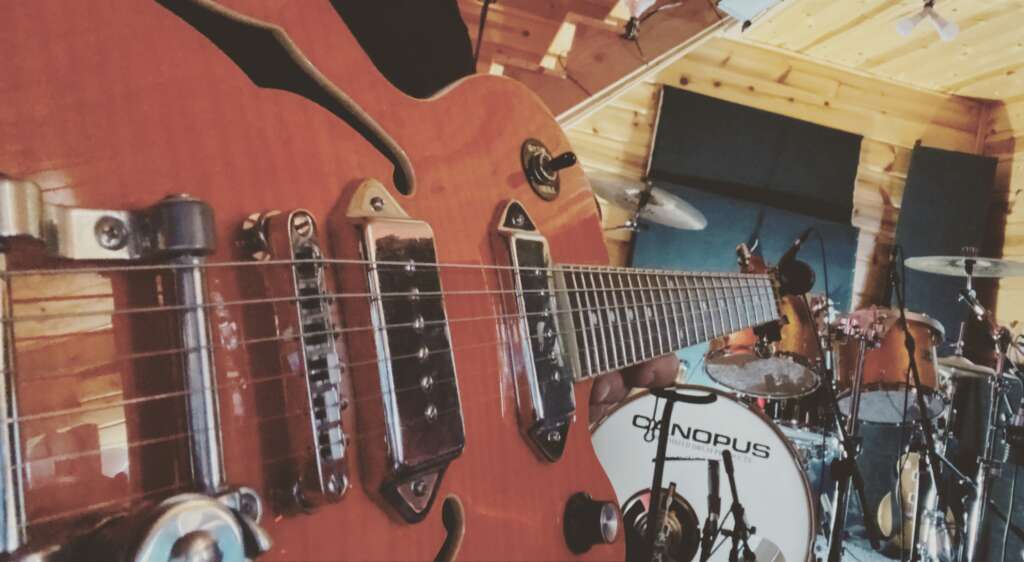
This week we’re talking about a technical guitar exercise to help you get control over your fingers. Gym 1 will help you find the buzz, which sets your finger pressure properly, and keep those fingertips closer to the strings. These two things work together to greatly reduce the strain on your fret hand as well as develop a solid technical foundation. It’s such a fundamental part of playing with ease and dexterity that it really does affect everything you do.
Awareness of finger pressure will help you with single note lines, chords, bends, and anything else you do with your fretting hand. It is the key to more fret hand endurance and speed. This is a concept routinely addressed in the classical world of guitar playing, but often overlooked in other genres. It’s also a skill that you will develop naturally with a lot of practice, but you can save yourself a good deal of time and trouble through awareness.
In concert with finger pressure is the height of your fingers from the strings. The further they are off the fretboard, the further they have to go to reach the string. That is, distance equals time in a proportional way. The greater the one, the greater the other. And the more time it takes to reach the string directly affects how fast you can play. It’s similar but quite the reverse with finger pressure. The harder you’re pressing, the slower your finger can lift off the fretboard, which also hinders your speed.
Keep in mind that there are times when you want your fingers a little higher off the strings, such as a hammer-on. If you’re trying to get a solid hammer-on with your fingers practically brushing the strings, you may find you struggle. In this case you need the distance to create enough force. But, other than a couple exceptions, keep those fingers tight on the strings!
How do I practice this?
Look, I get it, everything on guitar becomes a speed exercise. Cool, I learned this new pattern, now I’ll play it as fast as possible. You can really shoot yourself in the foot with this approach. Learning an instrument is all about deferred gratification. If you spend the time and do it right, you’ll get where you want to be much faster and have a lot more fun. Or you can shoot for short-term satisfaction and put a thick ceiling over your head. This way you may find yourself wondering how those great players ever got to where they did. Must be natural talent, must be magic, must be something I don’t have. Not true.
This exercise is particularly not about speed. In fact, if you’re playing it fast you aren’t getting what it’s meant to give. Pay attention to every movement of your hand, every finger and how hard it’s pressing down, how high off the strings it is. Move one finger into position while paying attention to how all your other fingers behave. Adjust each finger individually if you have to. Make them obey you. Do it slowly. You’re training complete idiots, so give them the time and space to overcome their learning disabilities.
You don’t need a metronome for this exercise.
Does this apply to anything real?
The thinking patterns and technique you will develop with this exercise should bleed over into everything you practice. Whether it’s a chord or single note line, you should be looking for the minimal required finger pressure and height off the strings. This is simple economy of motion. Do only as much as you have to. When you play this way your fret hand will be dramatically less taxed. Always be on the lookout for the least demanding way to play something. It’s hard enough getting to a note or chord, don’t make it harder than it has to be to hold those notes and chords.
For more, check out the video!